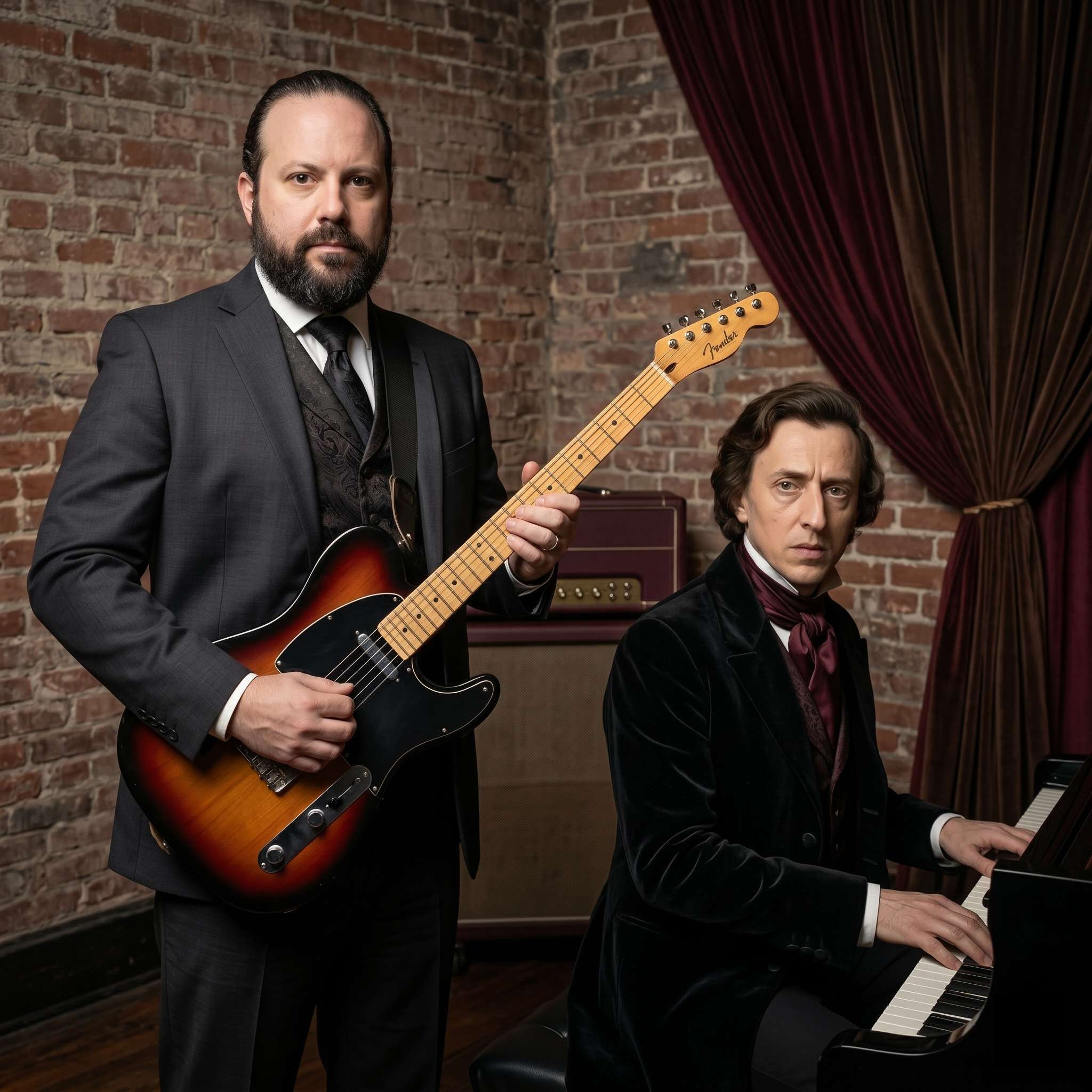
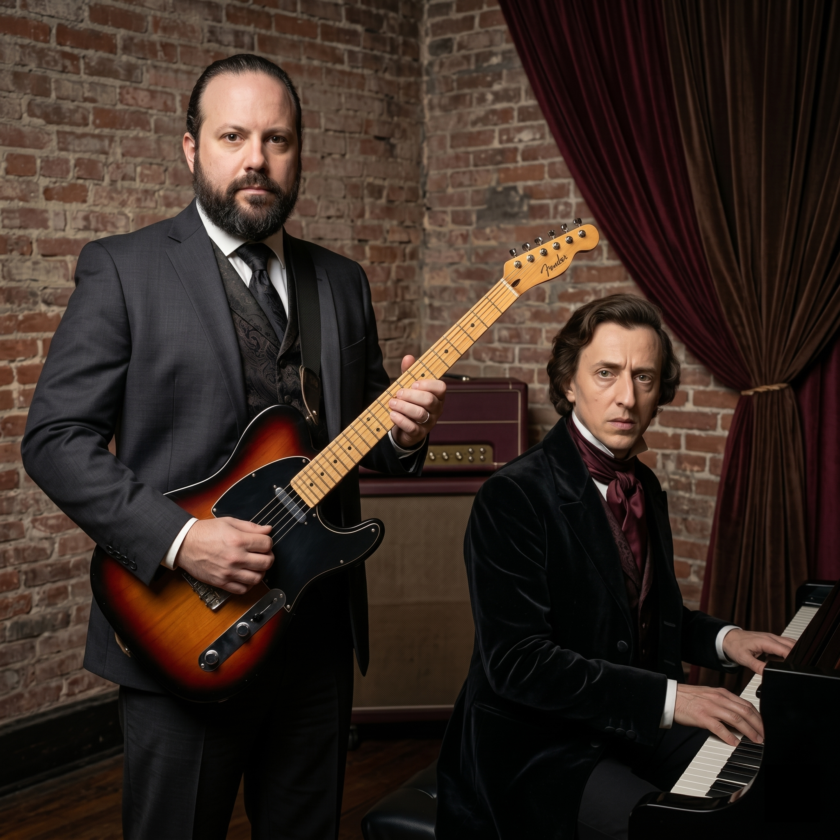
Few artists possess the rare ability to bridge seemingly distant worlds with such authenticity and brilliance as Ben Aubergine. A gifted multi-instrumentalist, accomplished physician, devoted husband, and father, Aubergine’s story is one of discipline, reinvention, and an unwavering devotion to creative expression. His musical journey began at just eight years old with a guitar in hand and an instinctive ear that quickly revealed an extraordinary natural talent. What started as childhood curiosity soon developed into years of refinement, experimentation, and artistic discovery, eventually shaping him into a musician with a singular creative vision.
While life led him toward a demanding and highly respected career in medicine, music never loosened its grip on his imagination. Instead, it quietly evolved alongside him, waiting for the moment when experience, maturity, and technical mastery would align. Now, with the confidence that comes from a life fully lived and a career firmly established, Aubergine has returned to his first love with remarkable purpose, channeling decades of musical insight into work that is both daring and deeply personal.
What makes Aubergine’s artistry so compelling is his fearless originality. Rather than follow trends or replicate familiar formulas, he has embarked on the ambitious task of reinterpreting Frédéric Chopin’s iconic Opus 28 Preludes as a cohesive modern rock experience. It is a concept as intellectually fascinating as it is creatively bold, transforming timeless classical compositions into immersive, high-gain alternative soundscapes while preserving the emotional depth and complexity that made them masterpieces in the first place.
In this conversation, Ben Aubergine opens up about the musical influences that shaped him, from the melodic genius of Buddy Holly and the raw immediacy of Nirvana to the enduring brilliance of The Beatles. He reflects on balancing creativity with medicine and family life, the technical challenges of translating classical piano works into modern rock arrangements, and his vision for where his artistic evolution will lead next.
This interview offers a fascinating look inside the mind of an artist whose work proves that true creativity is never confined by time, profession, or expectation. Ben Aubergine is not simply revisiting music, he is redefining what it can become.
To begin, could you introduce yourself to our readers and share a little about your journey as an artist, including how music first became such an important part of your life?
I’ve been a musician for a long time. I started when I was eight years old and my parents bought me a guitar. I was just messing around with it, but I had this knack for picking out notes by ear. I distinctively remember figuring out the solo to “Patience” by Guns N’ Roses. I had absolutely no idea what I was doing technically, but I could hear the melody and find the notes on the fretboard. Once my parents saw that, they put me into formal lessons. I played in bands all through high school and college, but at some point, I became really interested in fingerstyle guitar. I ended up spending about ten years refining that technique.
I wanted to learn how to translate full-band compositions into these rich, self-contained fingerstyle arrangements that sounded massive and complete rather than just strumming basic cowboy chords. After college, music had to take a back seat as I transitioned into a career in medicine. But now that my career is established and that trajectory in my life is secure and defined, I’ve finally found the time and space to come back to it. I built a sophisticated home recording studio, and now a significant portion of my life is dedicated to writing, arranging, recording, and creating music.
❖ Every artist has defining influences that shape their creative identity. Looking back, which musicians, composers, or albums had the biggest impact on your artistic development?
My very earliest influence, my real musical awakening, was Buddy Holly. For some reason, as a ten-year-old kid, that is what I latched onto. He wrote clean, fun pop songs, all less than three minutes long, but it was the perfect introduction to music because Buddy Holly’s work contained every necessary element of rock and roll: great melodies, energy, guitar solos. He was my first musical hero, and I absolutely devoured his entire catalog. Moving into my teenage years, I transitioned to Nirvana, which frankly isn’t as big of a leap from Buddy Holly as people might think. It has those exact same core elements, just with the gain turned up to eight and much better drumming.
You still have short songs with outstanding, hooky melodies that were incredibly relatable, especially to a fifteen-year-old in the nineties. Another presence that has been with me for my entire life is The Beatles. Their music has this amazing ability to cross genres, continents, and generations. At times some of their tracks sound like they are straight out of the 1920s, and other times I hear the absolute roots of early heavy metal. For the most part, it is just flawlessly constructed rock and pop music with unforgettable hooks.
You’ve worn many hats throughout your life as a musician, physician, husband, and father. How have these different roles shaped the way you approach creativity and artistic expression today?
When you’re a young musician, music is so often tied directly to your identity, your financial survival, or a constant need for external validation. A lot of the creative decisions you make are ultimately just solutions to problems involving those factors. You are constantly balancing art with the need to fit a mold or make a living. But when you have an established career entirely outside of music and a stable family life, it changes the stakes completely. Your trajectory is already secure no matter what artistic choices you make. Music is no longer a tool for survival or status. That security is exactly what allows me to take on a highly specific, ambitious project like a rock reinterpretation of Chopin. I don’t have to worry about commercial viability or broader market appeal. I can do it purely for the sake of the art itself.
You’ve chosen to reinterpret the entire Opus 28 Preludes as a cohesive rock album. Why did these particular works resonate with you so strongly, and what makes them especially suited for this kind of transformation?
I spent a few years in my twenties listening exclusively to classical music. I just dove headfirst into that world, and the music that resonated the strongest was solo piano, specifically Beethoven, Rachmaninoff, and Chopin. The gateway work for me was Chopin’s Sonata No. 2. Those opening bars of the first movement are still some of the most moving measures of music in existence. But over the years, I developed a particular love for preludes. They are short, brilliant, and unique. In a way, they share a clear DNA with the pop music of Buddy Holly or Nirvana. They are these perfect, bite-sized pieces of music.
I mean, I love a massive, forty-minute sonata, but a prelude is…it’s like the appetizer of the classical world. Like, with Chinese food, sometimes the best meal is just putting together five or six great appetizers. Who needs a main course when you have an egg roll, a potsticker, and crab rangoon? That is how I feel about these pieces. Chopin and Rachmaninoff wrote the greatest appetizers in the history of music. That realization got me thinking about historical limitations. When Chopin was composing, he only had the tools of his era: acoustic piano, strings, woodwinds. He did not have electric guitars, basses, synthesizers, or digital audio workstations. He was confined to the technology of the nineteenth century. So I started wondering, what if Chopin lived in modern times? What if he were writing for modern listeners with modern tools? Would he sound like The Beatles or Stevie Wonder? Or would it be more proggy like Yes or Genesis? Metal? I don’t know.
When you analyze Chopin’s piano writing, all the elements of a full band are already right there on the page. You have a clear lead melody, driving bass lines, the mid-range harmonies, and an underlying rhythm. It’s pretty natural then to visually unpack that and assign those components to a modern band setup. I could have tried this project with other classical works, but Opus 28 is uniquely suited for it. Each prelude is completely distinct, short enough to keep a modern listener engaged without getting tedious, and wildly varied in energy, mood, and tempo. It allows me to explore a dozen different rock styles within a single cohesive album, ultimately answering the question: if Chopin were alive today and freed from the limitations of the piano, what might his music sound like?
Your first release, Prelude No. 4 in E Minor, takes Chopin’s haunting chromatic tension and pushes it through a high-gain alternative rock lens. What were the biggest creative and technical challenges in translating such delicate classical emotion into something heavier and more aggressive?
One of the first structural decisions I made was that there would be absolutely no piano allowed in the music. If the goal is to fully reimagine piano literature within a rock framework, keeping a piano, even in the background, feels like a crutch. It is the studio equivalent of a live singer blending in prerecorded vocal tracks. I just think it compromises the core premise. So, rule number one was zero piano. From there, the technical challenge became note assignment. On paper, it sounds straightforward: assign the lowest notes to the bass guitar, the highest notes to the lead guitar melody, and fill the middle with rhythm parts. With Chopin, it’s never that simple. His voice-leading is intricate, and the notes driving the emotional dissonance are often buried right in the middle of the keyboard rather than sitting clearly in the melody line.
I had to deconstruct the score to identify the essential harmonic components and then experiment with arrangement and instrumentation. Then you run into pure execution issues. Some pieces translate naturally to a fretboard, but others feature blistering sixteenth-note runs at an already rapid tempo. Take Prelude No. 3 in G major, where the left hand is moving incredibly fast through the entire piece. Replicating that on a guitar can easily sound choppy and unnatural, so I have had to solve those technical hurdles by altering tempos and using alternate tunings. There was also the question of stylistic fidelity to the score. I realized quickly that while you can remain entirely true to Chopin’s chordal tones and textures, you cannot do it by just playing the exact notes on the page. A solo piano piece blends its frequencies naturally in one acoustic space.
When you pull it apart for a multi-instrument rock band, you have to extract the underlying harmonic flavor and write distinct basslines and rhythm guitar parts from scratch. You are essentially dissecting a masterpiece, breaking it down to its DNA, and reassembling it so that it functions as a cohesive rock track while remaining fundamentally recognizable as Chopin. So I had to figure out how, and when, to respectfully add notes to the original score without compromising the integrity of the composition.
Music often evolves alongside life experience. How would you say your perspective as a songwriter and multi-instrumentalist has changed compared to when you first started creating music in your younger years?
In my teens and early twenties, my writing was strictly autobiographical. I wrote about specific events that happened to me or specific people in my immediate circle. I would often take a single, literal moment from my own life and stretch it into an entire song. The focus was entirely on my immediate reality and my own interpersonal relationships. As I’ve gotten older, my perspective has zoomed out.
The ideas I want to explore now are much broader and less confined to my own literal experiences. I am noticing connections and patterns in the world that completely passed me by when I was younger. For example, instead of writing a song about one specific individual I know, I now find myself writing about an archetype. I focus on a type of person or a broader behavioral pattern, whether that specific person is actually in my life or not. The objective has moved away from simply documenting my personal timeline and toward analyzing broader concepts.
Looking at the broader picture of your career, what do you hope listeners connect with most when they discover your work for the first time?
I try to build a specific type of musical complexity into my work. When you analyze a lot of modern pop music, you often find a distinct lack of dissonance. But dissonance is the fundamental musical tool required to express pain, turmoil, and discontent. A song that entirely lacks dissonance will generally sound light and universally pleasant, but it will also lack depth. To convey anything heavier, you have to utilize unexpected chordal relationships, shifting timings, and unconventional supporting notes underneath what might otherwise appear to be a simple lead melody. All of these structural choices are intentionally designed to sound unsettling.
They replicate the feeling of discomfort. Conversely, you can use these exact same tools to express happiness, clarity, freedom, or relief. You achieve that, not by avoiding tension entirely, but by deliberately introducing it and then strategically removing it. And the contrast is what creates the emotional payoff. For me, music that lacks this push and pull falls completely flat. I want people who listen to my music to recognize the tension. I want them to engage with the discomfort it creates and then actually feel the weight of the release when that tension resolves. That cycle of tension and release is fundamentally what makes music compelling.
As someone who writes, arranges, records, and mixes everything yourself, how does working independently shape the sound and identity of your music compared to collaborating within a traditional band structure?
It actually makes things a lot more challenging than it probably could be. When you look at the greatest songwriters of our time, they were often collaborators: John Lennon and Paul McCartney, Simon and Garfunkel, Elton John and Bernie Taupin. There is a specific creative energy that comes from having another person to bounce ideas off of, or even to compete with, that pushes you to write better music. Working completely independently means I am missing that natural dynamic, so I have to be incredibly vigilant about the pitfalls. Am I leaning on a specific musical tool too many times? Am I overdoing a particular section? How was that vocal take? Are the lyrics as sharp as they can be? Does this track need more reverb? Is the song even any good in the first place? To counter that isolation, I end up leaning heavily on the people in my life who I know will give me a completely straight answer, which is primarily my wife and my daughter.
At least once a week, I am dragging them into the studio to listen to the most recent mix of a song just to see if I am on the right track. It is a funny psychological space to occupy. Part of you knows you are onto something good, but there is always that voice in the back of your head asking, “But am I really?” Having someone confirm that trajectory goes a long way toward giving you the momentum to finish the track, wrap it up, and move on to the next song. I honestly cannot imagine operating with absolutely zero outside input. No matter how confident you are in the value of what you are creating, you are always wondering if you are accidentally making it worse through sheer isolation.
In a traditional band structure, those course corrections happen organically during rehearsals or writing sessions. On the flip side, there is undeniably a unique freedom in not having to negotiate or defend a concept when you are completely certain of a musical direction. But on the whole, I highly value that collaborative friction, and it is absolutely something I miss and have to actively seek out.
You describe music as something that stayed with you as a creative anchor while life led you toward medicine, marriage, and fatherhood. How did those years away from fully pursuing music shape the artist you are now?
The most significant takeaway from that time is learning that you do not have to be an “artist” in the traditional, all-consuming sense to actually be an artist. You can be a recording musician at a very high level without that pursuit entirely defining your identity. It does not matter if you are a doctor, a teacher, a chef, or working in construction. You can hold a sizable creative space without letting it take over everything else. Music occupies a considerable part of my life now, but I have the ability to turn it on and off based on my immediate needs. If we are going on a family vacation, or if I need to focus heavily on clinical work for a few weeks, I don’t have to force the artistic side.
I can just stop. Then, when the timing is right, I can turn it right back on, step into the studio, and resume that creative output. That’s the distinct advantage of experiencing life outside of a dedicated musical career. I originally assumed that because I did not go down a professional musical path, music would never be a serious priority beyond strumming a guitar at home and learning a few solos. Instead, I discovered that stepping away actually gave me the flexibility to incorporate serious artistic work on my own terms.
Once the Opus 28 project is complete and these earlier creative chapters are finally closed, what can listeners expect next from Ben Aubergine, and how do you see your artistic evolution unfolding from here?
The Chopin preludes are going to take a considerable amount of time. The first few came together relatively quickly, but the more complex pieces require a high level of technical precision to translate accurately from piano to guitar. I am approaching them methodically, one by one, with the goal of finishing all 24 preludes within the next year. I will be releasing them individually as singles, but eventually, I intend to go back and repackage the entire collection into one cohesive album. And I’m also working on original music that I wrote back in my teens and twenties but never officially tracked.
I plan to follow the exact same rollout strategy for that material: putting out individual tracks as they are completed, and then later releasing the previous music as a complete package. Beyond that, I will eventually start focusing on brand new compositions. I keep a digital notebook filled with ideas for lyrics, chord progressions, and song structures that I want to develop. If the preludes are successful, I would love to tackle another major classical work. I think it would be fascinating to see if I can translate an entire piano sonata for a modern rock band. For example, imagining what all three movements of Beethoven’s Moonlight Sonata would sound like arranged for a five-piece rock band is a really compelling concept.
It presents an extreme technical challenge. A two-minute prelude is one thing, but managing the volume dynamics, energy shifts, and structural ebbs and flows of a continuous twelve-minute sonata movement is an entirely different undertaking. I probably have more projects lined up than I can reasonably handle, but that’s the beauty of operating as an independent musician. I can execute all of this strictly on my own timeline and release the music as it is made.