
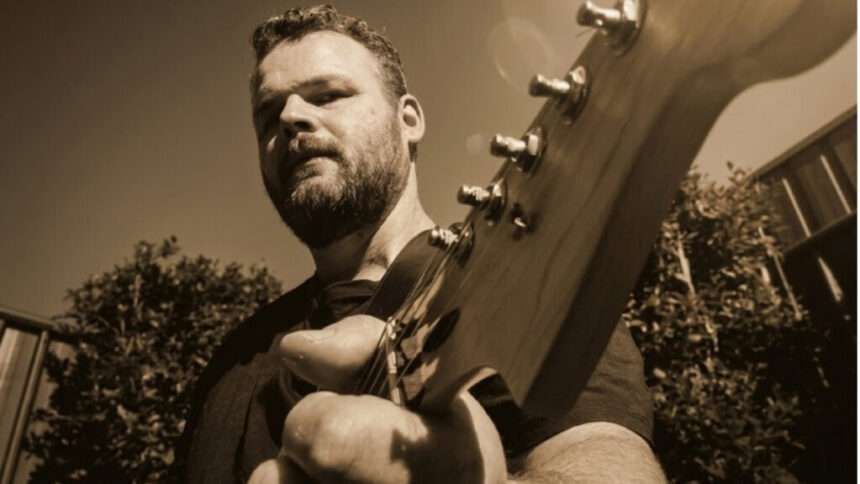
There is something quietly compelling about artists who don’t chase trends or attempt to manufacture larger-than-life personas. Instead, they allow their music to speak from lived experience, trusting that honesty will always outlast spectacle. Dan Higgins is one of those artists. Originally from Monmouth in South Wales and now based in Adelaide, Australia, Higgins has spent years refining his craft, drawing from everyday life to create songs that are deeply personal, emotionally sincere, and remarkably relatable.
His relationship with music began at an early age when an uncle introduced him to his first guitar chords. From there, curiosity quickly became passion. Armed with a bass guitar he received for his thirteenth birthday, a tape recorder, a Casio keyboard, and an endless desire to experiment, Higgins immersed himself in songwriting long before professional ambitions entered the picture. Those early bedroom recordings eventually led to a school band, where performing original material became more rewarding than simply playing covers, laying the foundation for the songwriter he would later become.
After relocating to Australia at the age of nineteen, life naturally took priority over music. Like many creatives, Higgins found himself placing songwriting on hold while building a new chapter. Yet becoming a husband and, later, a father reignited a creative spark that had never truly disappeared. Determined not to let music become a forgotten dream, he challenged himself to write and record one song every month. What began as a personal commitment gradually evolved into something much bigger, ultimately becoming his forthcoming debut album, Twenty Twenty Six.
Rather than relying on elaborate concepts or fictional narratives, Twenty Twenty Six embraces the beauty of ordinary life. The album explores family, responsibility, personal growth, self-discovery, and the quiet moments that often define us without us even realizing it. Higgins writes with refreshing vulnerability, believing that authenticity creates stronger connections than perfection ever could. Whether reflecting on fatherhood, processing life’s transitions, or finding meaning in the routine journey home in his lead single “Commuting,” his songs invite listeners to see their own experiences mirrored in his.
Entirely written, performed, and recorded from his living room, the album is also a testament to Higgins’ independent spirit. Wearing the hats of songwriter, musician, vocalist, and producer wasn’t simply a creative choice but a necessity that allowed him complete freedom to develop his vision at his own pace. The result is a body of work that feels intimate, cohesive, and unmistakably personal, shaped by influences ranging from Britpop and alternative rock to melodic punk and indie music while maintaining a voice that is uniquely his own.
In this exclusive interview with Spinex Music, Dan Higgins reflects on the musical journey that began in his childhood bedroom, the inspiration behind Twenty Twenty Six, the stories that shaped songs like “Commuting” and “Night Light,” the challenges of balancing family life with creativity, and why emotional honesty remains at the heart of everything he writes. He also discusses his independent recording process, his approach to songwriting, and what success truly means as he prepares to introduce his debut album to the world.
For readers discovering your music for the first time, tell us a little about yourself and your journey as a songwriter?
I’m Dan Higgins, I’m originally from Monmouth (South Wales), but I moved to Australia when I was 19. I spend my first few years in Sydney, and have since settled in Adelaide.
My musical journey began in my early teens, one of my uncles taught me my first few guitar chords one Sunday evening, and I ran with it from that point on. I also got a bass guitar for my 13th birthday, which I still have!
I started writing songs as soon as I learned to string a few chords together. I remember I’d record using an old tape recorder with a built-in microphone, whilst using my dad’s old Casio keyboard as a makeshift drum machine, whilst strumming and singing. What made it more fun was listening back to it, and experimenting with improvised guitar parts over the top.
Fortunately, I found some like-minded friends at school, and we formed a band. Initially we learned a few cover songs, but quickly realised we much preferred writing and performing our own original music. As a group, we recorded a couple of EPs, and played gigs in the local area. I still miss performing with those guys, it was a really important part of my life!
After moving to Australia, music went on the back-burner for a while. I still played guitar and wrote the occasional song, but it was a fairly low priority for me at that time.
Since the birth of my daughter, I found a real desire to start writing and recording again. I was really concerned that she’d grow up with a father that had zero hobbies or interests. So I set myself a challenge – to write and record at least one song a month for as long as I could. I got to 13 songs, at which point I changed my focus to working on a bigger project.
‘Twenty Twenty SIx’ is the result!
Twenty Twenty Six is built around honest storytelling rather than grand concepts. What inspired you to embrace that approach, and what made you confident that these deeply personal experiences were the stories you wanted to share on your debut album?
To be honest, my life is the only thing I know well enough to write authentically about. My feeling is that if I tried to write about grand concepts, I wouldn’t be able to do it justice. As for having the confidence to share my experiences on the album? I still feel vulnerable releasing my songs! But I’d rather be completely open, in the belief that it will help my music be more relatable to anyone listening. My hope is that the emotional openness will lead to more genuine connections.
Your lead single, “Commuting,” finds meaning in one of the most ordinary parts of everyday life. What first sparked the idea for the song, and has your perspective on those quiet moments changed since writing it?
The concept came about organically if I’m honest! In its earliest iteration, ‘Commuting’ was the first song I came up with specifically for the album. I started with the guitars and bass.
Then when it came to the lyrics, I gave myself a day to get the lyrics written and recorded.
I didn’t actually have a concept for the song originally, but the idea of that slice of time between work and home kept coming into my head.
My guess is that having a time restriction makes the creative process a bit more interesting.
My perspective on those quiet moments hasn’t really changed, but I do make more of a conscious effort to not bring work related issues into the home.
The album touches on themes of family, personal growth, responsibility, and self-discovery. As you were writing these songs, did you find yourself learning something new about who you are, both as a musician and as a person?
That’s an excellent question! After getting married and starting a family, life is obviously very different compared to before.
I found writing songs has been a really useful way for me to process things. I’ve always wanted to be a father, and wanted to have a strong relationship with my children, which I think is reflected in a couple of the songs.
You chose to write, perform, and record the entire album yourself from your living room. What motivated you to take such an independent route, and were there moments when the challenges made you question the process?
One word – Necessity!
As you’ve alluded to, the songs are deeply personal.
Part of it is wanting to write from the heart, without having to justify certain decisions.
Another part of it is that I really want to learn and improve all the aspects of the writing/recording process.
One of the biggest challenges? Finding a moment where I had the house to myself long enough to record vocals!
Your music draws inspiration from Britpop, alternative rock, melodic punk, and indie music, yet the album never feels confined to one genre. How did you approach blending those influences while ensuring Twenty Twenty Six had its own unique identity?
I wish I had a better answer for this one. When I initially started writing music, I was focused on experimenting and playing around with ideas from scratch.
I learnt to play songs from the genres you listed, and I guess learning those songs influenced the way I play the guitar.
I also recall listening to some bands and thinking “wow I wish I could write songs like that, I have no idea where to start with it”… so I just started developing my own process.
Every album has one or two songs that unexpectedly become the emotional centrepiece. Was there a track that evolved in a way you didn’t anticipate, or one that revealed more about yourself than you initially expected?
That has to be “Night Light”, a song I wrote for my first daughter. It’s strange really, it’s the song that took the least time to write, was the quickest to record, the production was done speedily… but it’s the song people tend to resonate with the most by a large margin!
As a guitarist, songwriter, and producer on this project, you wore several creative hats. How did you know when a song was truly finished, and how did you avoid the temptation to keep revisiting and refining it?
Deadlines. I found it very helpful to set myself a time limit to get songs finished. It helped change my mindset from endlessly adjusting things, to getting songs to the point where they’re passable (for better or worse).
My theory was that it’s better to release something that is “good enough”, as opposed to having the “perfect track” sitting in a computer file that will never see the light of day.
In an era where music is often consumed one song at a time, you’ve chosen to release a cohesive album. Why was it important for you to tell a larger story through a full-length record, and what do you hope listeners experience from beginning to end?
Writing an album has been a bucket list item for me. Previously though, I’d never put that much forethought into it.
I’ve spent some time now recording single one-off tracks. I’ve enjoyed the process and I’m starting to see a progression from my initial efforts through to now. However, the songs have had relatively few listeners.
As you said, most people consume songs one at a time, so musicians are understandably releasing them one at a time.
So to answer your question, I’d say it’s a combination of wanting to try something different, and feeling more prepared to tackle a bigger project.
As for my hopes for the listeners – Simple put, I really hope that you enjoy it!
As you prepare to introduce Twenty Twenty Six to the world, what would success look like for you? Beyond streams and numbers, what impact do you hope this album has on the people who take the time to truly listen?
To me, success would be having people hear the album, and feeling a sense of connection with what they hear.
A major factor in wanting to write again, was a desire to process all the major life changes that have happened in the recent past. I’ve found music has certainly helped in that regard. If anyone else going through similar events hears ‘Twenty Twenty Six’ and can walk away afterwards with a feeling of empathy… I’d say that was a success.