


There comes a point when trying to save someone else starts to cost you pieces of yourself. The line between love and self-destruction can become dangerously thin, and sometimes the hardest truth to face is that walking away is not giving up. It is survival.
For Eye of TJ, that realization sits at the heart of “This Time,” a powerful new release born from the emotional wreckage of a relationship that demanded more than he could continue to give. The song does not simply revisit heartbreak. It confronts the damage left behind when you spend too long fighting for someone while quietly losing yourself in the process.
It also marks a major turning point.
With “This Time,” the Mobile, Alabama artist steps into what he calls “The Pivot,” moving toward a bigger, heavier and more ambitious sound built around massive melodic guitars, gritty vocals and the emotional weight of stadium rock. Yet beneath the scale of the production remains the storytelling instinct shaped by his Southern roots. Eye of TJ calls the result “Cinematic Grit,” a sound where widescreen rock production meets raw human truth.
The forthcoming album Endless War pushes that idea even further. It explores the battles that do not always end when a relationship does. Anxiety, trauma, memory and the echoes of painful experiences can continue long after the person is gone. For Eye of TJ, winning that war is not about defeating an enemy. It is about reclaiming yourself and finding the strength to keep moving, even when the scars remain.
His previous album, Everything I Didn’t Say, explored silence and the emotions left buried beneath it. Endless War is the sound of those walls finally coming down. It finds an artist becoming more direct, more vulnerable and increasingly unafraid to name the things that many people spend years trying to hide.
As his music approaches 100,000 career streams, Eye of TJ has also discovered that deeply personal songs can create something much larger than individual healing. Listeners have begun to form what he describes as a convoy, a community connected by shared struggles, survival and the difficult work of moving forward.
In this interview with Spinex Music, Eye of TJ opens up about the relationship that inspired “This Time,” the painful realization behind the song, his evolution from Everything I Didn’t Say to Endless War, the birth of his “Cinematic Grit” sound, and why “The Pivot” represents far more than a change in musical direction.
This is Eye of TJ stepping out from behind the silence and into the next chapter of the story.

“This Time” captures the painful moment when trying to save someone else begins to destroy parts of yourself. Was there a specific experience that made you recognize this emotional breaking point, and how difficult was it to turn something so personal into a song?
I wrote this about my last long-term relationship. On my debut album, the track ‘Letting Go of You’ was the first step—it was about the act of walking away, but I realized I never truly explained why. I was hiding the reasons behind a wall of silence. ‘This Time’ is me finally tearing that wall down. It wasn’t easy to write because it forced me to admit that I was complicit in my own exhaustion. Turning that pained ‘why’ into a stadium-rock anthem was cathartic—it turned a private breaking point into a public declaration of survival.
The line “I kept trying just to pull you through while I was losing pieces too” feels like the emotional center of the track. How did you arrive at that idea, and what does it reveal about the difference between loving someone and losing yourself while trying to love them?
That line came from the realization that I had become a ‘session musician’ in my own life—playing a supporting role while my own song was being silenced. There is a fine line between supporting someone and subsidizing their refusal to heal. True love is a partnership, but when you’re ‘losing pieces’ of your own mental health and identity just to keep the other person afloat, it’s no longer love—it’s a slow-motion wreckage. That line is the moment when I finally looked in the mirror and seen the damage.
“This Time” represents a clear move toward rock, with massive melodic guitars surrounding your gritty vocal delivery. What made this the right song to begin the transition from your earlier work into the Cinematic Country-Rock direction of Endless War?
Rock music has a weight to it that you can’t fake. My previous EP, Knowing the Risk, was a great exploration of my country roots, but for the story I’m telling on Endless War, I needed the ‘wall of sound.’ This song deals with an internal explosion, and only heavy, melodic guitars could match that scale. It serves as the ‘Pivot’ because it takes the storytelling of my Southern roots and injects it with the high-octane energy of 2000s-inspired stadium rock. It sets the stakes for the rest of the record.
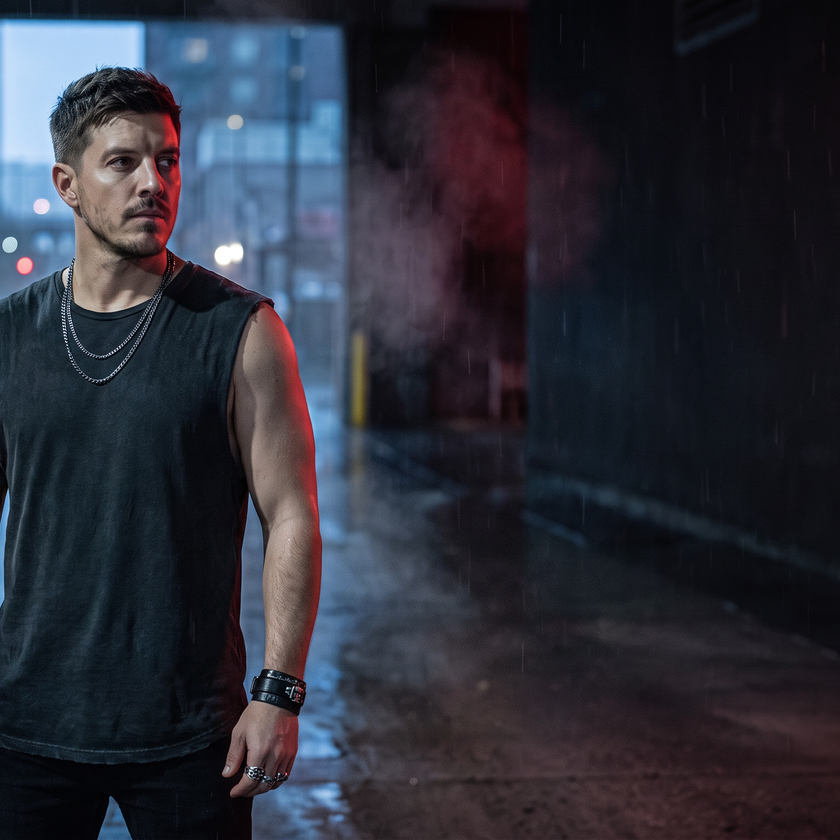
You describe your sound as “Cinematic Grit,” combining 2000s-inspired rock with the storytelling traditions of Heartland music. What does that phrase mean to you, and what do you believe distinguishes your approach from simply blending country and rock?
To me, ‘Cinematic Grit’ is about the contrast between a high-fidelity, widescreen production and the raw, unpolished truth of the lyrics. It’s not just blending genres; it’s about creating an atmosphere. It’s the ‘humid’ sound of a Mobile, Alabama summer night mixed with the ‘electric’ energy of an arena. What distinguishes it is the focus on the ‘unspoken moments.’ I want the music to feel like a movie for your ears—something that captures the texture of the backroads and the shine of the city at the same time.
The forthcoming album is titled Endless War, while “This Time” uses the language of battle to describe an emotionally destructive relationship. Is the album built around the idea that some personal struggles feel like wars we repeatedly fight, and what does “winning” actually mean within that metaphor?
Exactly. The ‘Endless War’ refers to the battles we fight long after the relationship is over—the battles with PTSD, anxiety, and the ‘echoes’ of the past. For many people in my ‘convoy’ of listeners, the struggle is daily. ‘Winning’ in this context isn’t about defeating an enemy; it’s about reclaiming your sovereignty. It’s finding the chance to heal and realizing that even if you’re permanently scarred, you aren’t destroyed. Winning is simply choosing to keep driving down that empty highway.
Your debut album Everything I Didn’t Say focused heavily on the emotions left behind after difficult relationships and moments of silence. What have you learned about yourself as a songwriter between that record and Endless War, particularly when it comes to saying the things you once left unsaid?
I’ve learned that there is a massive difference between observing your pain and owning it. Everything I Didn’t Say was a reflection on silence, but Endless War is the sound of that silence breaking. As a songwriter, I’ve become much more direct. I’m no longer afraid to use words like ‘PTSD’ or ‘depression’ or to admit when I’ve made mistakes. I’ve learned that the more specific I am about my own inventory of moments, the more universal they become for the listeners.
Your music has now moved from an initial 50,000-stream milestone toward nearly 100,000 career streams. How has seeing real listeners connect with stories that began as deeply personal experiences affected your confidence and your willingness to become even more vulnerable in your writing?
It’s a humbling feeling. When you hit 100,000 streams, you realize you aren’t just singing into a void—you’re leading a convoy. Knowing that there are people out there who feel less alone because of my ‘grit’ gives me the courage to go even deeper. It’s no longer just about my own healing; it’s about creating a space where we can all take an inventory of our unspoken moments together. That connection is what fuels the vulnerability on this new record.
Coming from Mobile, Alabama, how much does your Southern upbringing and the culture around you influence the way you approach storytelling, particularly when you are writing about masculinity, heartbreak, resilience and the complicated emotions people often struggle to express openly?
Mobile is a huge part of my DNA. There’s a specific kind of resilience in the South—a ‘get back to work’ attitude—but that often leads to people burying their heartbreaks. Growing up here taught me the power of a story told over a backroad drive or a quiet kitchen table. I try to bring that Southern honesty to the ‘Rock Pivot.’ I want to show that being ‘gritty’ and being ‘vulnerable’ are the same thing. You can be a man who is battle-worn and still have the strength to say ‘I’m not okay.’

You are calling this transition “The Pivot,” suggesting that this is more than a change in instrumentation and actually represents a new chapter for Eye of TJ. What are you deliberately leaving behind from your previous era, and what parts of that identity are essential enough to carry forward?
I’m leaving behind the hesitation. In the previous era, I was still testing the waters of how much I was willing to reveal. With the ‘Rock Pivot,’ the gloves are off. I’m leaning into a more aggressive, anthemic identity.
As Endless War approaches, what do you hope listeners understand about Eye of TJ that they could not have understood from Everything I Didn’t Say? And when this new chapter is complete, what would make you feel that “The Pivot” genuinely changed the trajectory of your music?
I want them to understand that EYE OF TJ is more than just a music project—it’s a survival guide. I want them to hear the growth from the pained silence of the debut to the triumphant liberation of the final track, ‘Free Spirit.’ If this record helps one person realize that they don’t have to stay in a situation that is breaking them, then ‘The Pivot’ was a success. When this chapter is complete, I want to look back and see a community—a convoy—that is moving forward together, leaving the war behind.
STAY IN TOUCH:
FACEBOOK | X | INSTAGRAM | SPOTIFY | TIKTOK | YOUTUBE