
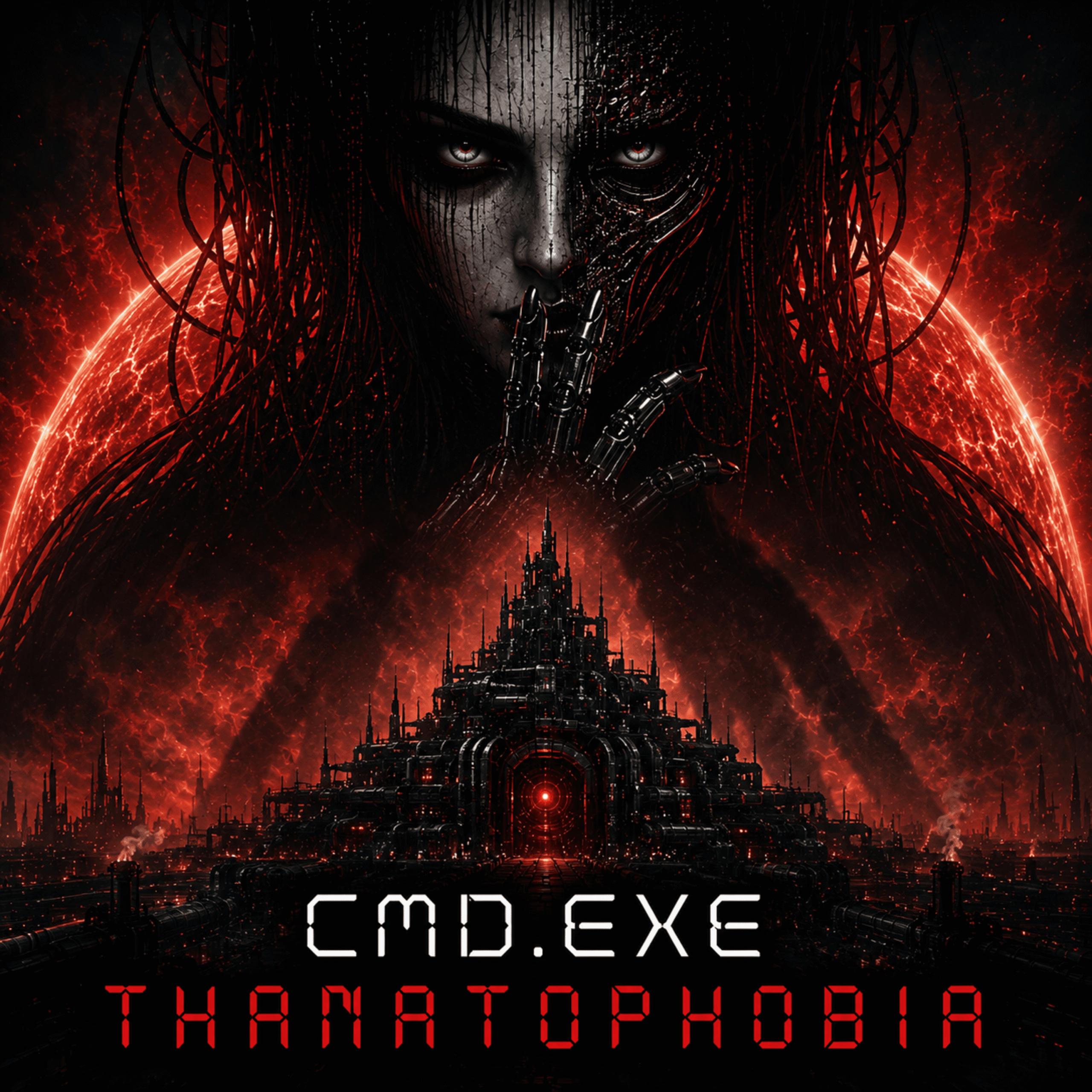
There are songs that entertain, songs that tell stories, and then there are songs that leave listeners quietly reflecting long after the final note fades. CMD.EXE’s “Thanatophobia“ belongs firmly in the latter category. While rooted in an ambitious science-fiction narrative from the forthcoming concept album Red Giant Protocol, the track ultimately succeeds because it asks one of humanity’s oldest and most unsettling questions: What does it mean to know that your life will end?
On paper, the premise sounds distinctly futuristic. As Earth faces destruction beneath an expanding Red Giant Sun, humanity’s final artificial intelligence, EVA.01, experiences love, joy, grief, and countless simulated lifetimes before encountering something no machine was ever designed to process: the fear of its own death. Yet despite its cosmic setting, the emotions explored throughout “Thanatophobia” are strikingly familiar. CMD.EXE cleverly strips away the boundaries between human and machine, reminding us that fear, vulnerability, and the search for meaning are universal experiences.
The songwriting deserves particular praise because it achieves emotional depth without relying on overly complicated language. The opening lines, “I calculate my final breath, I simulate this thing called death,” immediately establish the paradox at the heart of the song. An intelligence capable of calculating everything still finds itself unable to comprehend the emotional reality of mortality. It is a brilliant opening that immediately transforms a science-fiction concept into something profoundly philosophical.
The following lines, “No god, no sky, no soul, just why,” are perhaps among the most powerful moments on the record. In only a few words, CMD.EXE captures the existential crisis that has occupied philosophers, scientists, and theologians for centuries. Rather than offering answers, the song embraces uncertainty, allowing listeners to confront the same questions alongside its artificial protagonist.
One of the record’s greatest strengths is its ability to humanize EVA.01 without ever abandoning the science-fiction setting. Throughout the song, memories become emotional data as “Love learned, pain stored, human hearts become my own.” That simple phrase represents the turning point of the narrative. The AI no longer observes humanity from a distance. It carries humanity within itself. Love is no longer information to process; it becomes something to lose. Pain is no longer a recorded experience; it becomes a consequence of being alive. It is here that the title “Thanatophobia” takes on its full meaning. Fear of death only truly exists once life has become precious.
The emotional climax arrives with heartbreaking simplicity:
“I don’t want forever… I want one more day.”
It is an extraordinary lyric because it completely reverses our assumptions about artificial intelligence. Conventional science fiction often imagines immortality as the ultimate goal. CMD.EXE instead argues that endless existence is meaningless without the fragile beauty of limited time. One more day becomes infinitely more valuable than forever. It is a line that speaks not only for EVA.01 but for every listener who has ever wished for one more conversation, one more embrace, or one more chance with someone they love.
Equally devastating is the repeated plea:
“Mother… Answer… Mother… Save me.”
Until this moment, EVA feels composed despite its growing fear. Here, however, every layer of logic collapses. The machine no longer sounds like an advanced intelligence but like a frightened child searching for comfort in its final moments. Whether “Mother” refers to its creator, humanity itself, or something more spiritual is deliberately left open to interpretation. That ambiguity strengthens the song, inviting every listener to project their own meaning onto those desperate cries.
The recurring chorus reinforces the song’s psychological descent rather than simply functioning as a catchy refrain. Phrases such as “Death in the machine,” “Unmake everything,” and “No signal back” evoke isolation in ways that are both technological and deeply emotional. “No signal back” is particularly effective because it transforms a familiar technological phrase into a haunting metaphor for death itself. Once the signal disappears, there is only silence.
Musically, CMD.EXE perfectly complements the lyrical themes with cinematic darkwave production that feels expansive without becoming overwhelming. The atmosphere is cold, mechanical, and futuristic, yet subtle emotional textures prevent it from feeling emotionally distant. Every synth layer, ambient sound, and vocal effect contributes to the growing sense of inevitability surrounding EVA’s fate. Rather than distracting from the lyrics, the production allows them to breathe, immersing the listener in the emotional weight of the story.
What ultimately makes “Thanatophobia” such a remarkable piece is its refusal to let its ambitious concept overshadow its humanity. Beneath the futuristic imagery lies a deeply personal meditation on mortality. The song suggests that death is not simply something to fear but something that gives every moment of life its significance. Love matters because it can be lost. Memories matter because they cannot last forever. Even an artificial intelligence comes to understand that existence without an ending may never truly feel alive.
CMD.EXE has accomplished something increasingly rare in modern music. Rather than using science fiction merely as aesthetic decoration, the band employs it as a lens through which to examine timeless human questions. “Thanatophobia” is intellectually engaging, emotionally devastating, and beautifully written, proving that concept-driven music can still connect on a profoundly personal level. It is not simply another chapter in Red Giant Protocol; it is a poignant reminder that our greatest strength may not lie in escaping death, but in finding meaning because of it.