
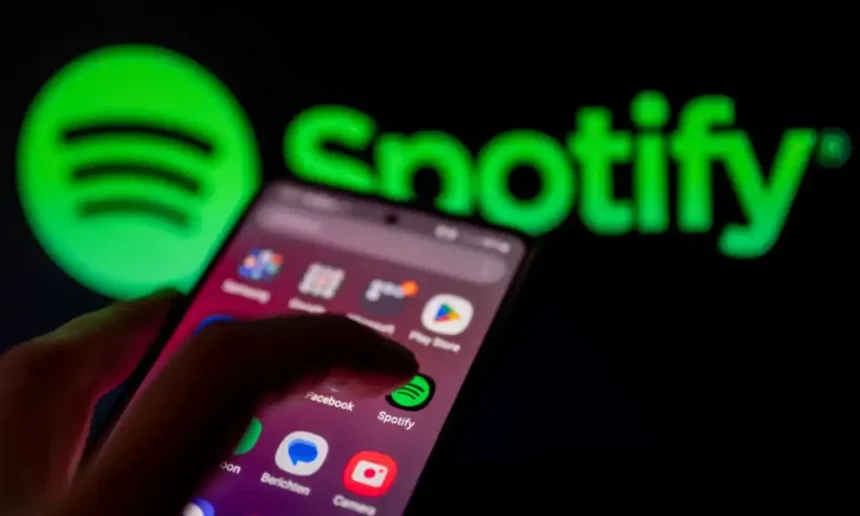
Tuesday morning arrives with the alarm you’ve been ignoring for fifteen minutes and somewhere between the first groggy breath and the stumble toward the coffee maker your hand finds your phone with the practiced muscle memory of addiction. The Spotify app is already open because you fell asleep listening to it last night, the screen glowing green in the half-dark of your bedroom, waiting for you to tell it what mood you’re in today, what energy you need, what soundtrack will carry you through the next eight hours of your life.
The playlist loads without conscious thought on your part, maybe Today’s Top Hits if you want to feel current, maybe RapCaviar if you need that morning aggression, maybe one of the eight billion user-curated playlists that exist on Spotify alone, each one a small universe of taste and intention built by someone you’ll never meet. You don’t question the songs that pour into your ears while you shower and dress and pretend to wake up. You don’t wonder about the invisible hand that selected this particular track over ten thousand others, that decided this beat deserves to shape your morning while countless other beats disappear unheard into the algorithmic void.
But someone did make that choice. Someone who isn’t employed by Spotify headquarters or drawing a salary from a major label or sitting in an A&R office downtown. Someone who’s in their apartment right now at this exact moment listening to their nine-hundred-and-forty-seventh song submission of the week and evaluating whether this track will resonate with the 50,000 people who follow their playlist about late-night drives or morning workouts or heartbreak or whatever niche they’ve carved out of the infinite streaming landscape. They’ll write a quick review then they’ll hit “approve” or “decline,” and the artist who submitted that track will either get a shot at being heard or will disappear back into obscurity. The curator will get paid between $1 and $14 for this three-minute interaction, regardless of their decision, regardless of whether the song was brilliant or garbage or somewhere in between.
Welcome to the playlist economy, where gatekeeping that used to be reserved for radio program directors has been democratized into a side hustle that pays better than most people’s day jobs.
The Last Generation of Radio DJs Didn’t Know They Were the Last
Let’s rewind. Not too far back, just to when radio DJs were gods. From the 1950s through the early 2000s, being a radio program director meant controlling what millions heard, the path to stardom running through a handful of powerful gatekeepers sitting in climate-controlled offices deciding what America would hear while driving to work.
These people had actual careers with $40,000 to $80,000 annual salaries, health insurance that covered their families, retirement accounts that would someday fund their golden years, business cards embossed with titles like “Music Director” or “Program Director.” The industry treated curation as a skilled profession requiring years of experience, carefully cultivated relationships, and an ear tuned to what worked on the airwaves and what died in the late-night slots nobody remembered.
Record labels knew this power was worth paying for, spending millions on radio promotion and cultivating relationships with these gatekeepers through methods that ranged from the genteel to the criminal. The payola scandals of the late 1950s, 1980s, and early 2000s proved what everyone already knew: access to radio was for sale, and whoever paid the most got their songs played the most, legality be damned.
But payola was technically illegal, at least when you got caught, with stations required to disclose when they were paid to play something in a disclosure requirement that was supposed to level the playing field but never actually did because the money just got more creative, flowing through third-party promoters and “independent” radio pluggers and consulting fees that kept the game exactly the same while giving everyone better lawyers who could argue the technicalities.
Then streaming arrived and shifted the entire power structure, radio losing its grip on discovery as playlists became the new gatekeepers. By the late 2010s, the change was undeniable. Data from 2017 to 2018 showed that mainstream radio was playing catch-up rather than setting trends, with pop songs blowing up on Spotify weeks before they cracked the radio top 50 and rap artists like XXXTentacion placing 29 songs in Spotify’s top 50 with almost zero radio airplay.
Music industry veteran Bob Lefsetz nailed it in his 2017 newsletter: “By waiting so long to go on tracks and sticking with them radio is clogging the arteries, and signing its own death warrant. Who in hell is gonna tune in to hear that which was a hit months before? NOBODY!”
Radio DJs saw their influence diminish as the offices downsized and the business cards became less impressive, but the role of curator didn’t disappear so much as it multiplied and democratized, spreading from a hundred professional program directors making steady salaries to thousands of bedroom curators making anywhere from beer money to full-time income depending on how effectively they could build and maintain their playlists.
How to Make $100 an Hour Listening to Music in Your Pajamas
Lance Tingey was pulling down a decent salary as a Marketing Manager at LinkedIn in San Francisco when October 2020 arrived with its COVID shutdowns and existential reckonings, the moment when comfortable became suffocating and the nine-to-five started feeling like a cage. He quit, but not for another corporate job with better benefits or a fancier title. He quit to become a full-time Spotify playlist curator, a decision that probably made his parents question where they went wrong with his expensive college education.
Sound insane? By six months in, he was pulling in $4,000 to $5,000 per month, with $2,500 to $3,500 of that pure profit after expenses, working about an hour per day from his apartment while the rest of his former LinkedIn colleagues sat through Zoom meetings about quarterly projections and synergy. When you break it down hourly, he was making close to $100 an hour doing something most people don’t even consider work: listening to music and deciding what belonged on his playlists.
The math that led him here was brutal and illuminating in equal measure. Before he quit his day job, Tingey was spending $15 to $30 per day on Facebook ads to promote his own music as an alt-pop singer-songwriter, watching the costs accumulate like water torture: $200 per week, almost $1,000 per month, a whopping $10,000 per year hemorrhaged into the digital advertising void with minimal return. Then he figured out he could flip the entire model, stop paying for promotion and start getting paid to provide it, positioning himself on the other side of the transaction where the money flows in instead of out.
The curator economy runs on a simple principle: artists need playlist placement more than anything else in the modern music industry, and curators with engaged followers can provide that placement. The connection happens through submission platforms, the services artists use to put their tracks in front of curators who might add them to playlists.
Submission platforms operate on similar models: curators with established playlists and real follower bases sign up to review songs from artists who pay for the opportunity to be heard. Pay rates vary based on playlist size and engagement typically ranging from a few dollars to around $15 per review. The crucial distinction between this and the payola radio was guilty of is that artists are paying for consideration and feedback not guaranteed placement. Curators review the submission, provide their honest assessment, and only add tracks to their playlists if the music genuinely fits their audience and their taste.
For curators who can build multiple playlists across different genres, the math becomes compelling. Review 50 to 100 submissions per day at an average rate, maintain real engagement with actual listeners who trust your curation, and the income adds up quickly. Some independent curators earn several hundred dollars a month as a side income, while others have turned curation into full-time work, building businesses around their ability to discover music and serve their audience.
Compare that to the radio DJ salaries of the past or the streaming payouts artists receive, and the economic model looks very different. Spotify paid out around $60 billion total since its inception, a staggering sum that gets spread across millions of artists in quarterly royalty statements that arrive months after the streams happened, the revenue split between labels and managers and streaming platforms until the artist gets whatever remains. Curators earn per review through the submission platforms, though like artists they also must reach minimum payout thresholds before receiving payment.
The Professional Track: When Curation Becomes a Real Job
Not everyone’s making playlist money in their bedroom at three in the morning between Netflix binges and existential crises. Some curators went legit, turned the side hustle into a real career complete with health insurance that covers dental and 401(k) contributions that might someday fund an actual retirement instead of working until death.
According to ZipRecruiter,the average playlist curator salary in the United States is $72,627 per year, though that number masks a massive range where the bottom 25th percentile makes around $50,000 while the top 75th percentile pulls in $94,000 and the true earners in the 90th percentile are making $111,500 annually. These are the curators who’ve turned their playlists into legitimate businesses, working full-time to discover music, build audiences, and maintain the kind of engaged followings that make their curation valuable to both artists and listeners.
The Scam Economy: Where There’s Money, There’s Fraud
Of course, whenever there’s a new way to make money, there’s a new way to fake making money, and the playlist curator economy has spawned an entire shadow industry of scam services promising guaranteed placement for a fee while delivering bot streams and fake followers, taking artists’ money and providing exactly nothing of value in return except maybe a harsh lesson about trusting strangers on the internet.
The playbook is always the same, refined through repetition until it’s almost elegant in its simplicity. A service claims to have relationships with “hundreds of influential playlist curators” who are just dying to hear your music. They promise “guaranteed placement” on playlists with “millions of followers” that will definitely launch your career into the stratosphere. Artists pay anywhere from $50 to $500 per track, sometimes more if they’re really desperate or really naive. The track gets added to playlists that look impressive at first glance with their 50,000 or 100,000 followers, but look closer and you’ll see the streams are pure garbage, bot accounts and ghost listeners and fake engagement that does absolutely nothing for the artist’s career and might actually hurt it by training Spotify’s algorithm to think the track is worthless.
Spotify’s algorithm prioritizes listener behavior, paying attention to track completion rates and repeat listens and saves and playlist adds and shares, all the signals that indicate genuine human engagement with music rather than robotic compliance with programming. When a song gets added to a bot playlist, listeners skip it immediately if they listen at all, and the algorithm notices this rejection, marking the track as low quality and decreasing the artist’s chances of genuine algorithmic promotion in the future, the fake streams actually poisoning the well they were supposed to fill.
Legitimate submission platforms make the distinction clear: they’re charging for consideration, not placement. Artists pay for real curators with real audiences to actually listen and provide feedback. The curator still decides whether to add the track based on fit. No guarantees. Just honest evaluation.
But the scam services are literally selling fake streams, modern fraud dressed up as legitimate promotion. They exploit artists who don’t know how to distinguish real curation from manufactured numbers, taking money from people who are already struggling to be heard and delivering nothing but bot engagement that can actually damage their algorithmic standing.
The platforms know this is happening. Spotify knows. They’ve implemented measures. In 2024, they introduced a minimum streaming threshold of 1,000 streams per year for tracks to generate royalties, demonetizing about 60% of tracks on the platform. The official reason? Combating streaming fraud. The revenue from tracks that don’t hit the threshold gets redirected to tracks that do, an arbitrary threshold that primarily hurts independent artists while funneling more money to already-successful tracks.
The curator economy has created a marketplace where legitimate services exist alongside fraudulent ones. Legitimate platforms emphasize that they don’t support guaranteed placements, using models where artists pay for submissions and curator consideration, not for adding tracks regardless of quality. That distinction defines the difference between ethical promotion and exploitation.
But for every legitimate service, scam operations multiply. For every curator building a genuine audience others buy fake followers to inflate their numbers and charge higher submission fees. The industry is still developing standards to separate legitimate curation from fraud, trying to preserve the democratizing potential of independent playlist culture while preventing it from becoming another avenue for scammers to exploit desperate artists.
The Independent Curator: Democratization or Exploitation?
So if Spotify’s editorial playlists are controlled by a faceless team of editors with potential conflicts of interest, and if algorithmic playlists are influenced by Discovery Mode’s pay-to-play mechanics, where does that leave independent curators?
Independent curators are the grassroots of the playlist economy, music fans who’ve built followings by creating niche playlists that reflect specific moods or genres or aesthetics, people who aren’t employed by Spotify or beholden to major labels but are just fans who love music and have the time to curate it with obsessive attention to vibe and flow. And holy shit, they’ve become powerful in ways that would have seemed impossible ten years ago when streaming was still finding its footing and playlists were just a feature nobody had figured out how to monetize.
One independent curator describes how their playlist pushed a song 2.2 million times through Spotify’s algorithm based solely on the playlist’s listener behavior and the artists included, the success coming entirely from genuine listener engagement rather than paid promotion or label connections or any of the traditional industry leverage that used to determine what got heard and what didn’t. “Curators are the most important thing to happen to music since streaming,” the curator writes with the confidence of someone who’s watched their hobby become an industry. “Together with artists, we can see the industry shifting.”
But the curator economy isn’t some utopian meritocracy where the best music automatically rises to the top. The shadow industry of fraudulent “playlist placement services” exists alongside legitimate platforms, promising artists guaranteed spots for fees while delivering bot streams and fake engagement. Legitimate platforms distinguish themselves by emphasizing consideration over guaranteed placement, connecting artists with curators who genuinely listen and evaluate submissions.
The distinction matters in theory: paying for the opportunity to be heard by a curator is fundamentally different from paying for a guaranteed placement regardless of quality. But from an artist’s perspective trying to break through in an industry uploading 60,000 songs per day, that line between ethical promotion and questionable practice can feel increasingly abstract when facing rejection after rejection.
Who’s Really Getting Rich Here?
The money flows through multiple channels in the curator economy creating income for different participants while raising questions about sustainability for artists.
Spotify paid out $10 billion to the music industry in 2024 alone, representing real careers and real income for many artists. However, with 12 million artists distributing work through the platform, the average comes to $833 per artist for the entire year. That average masks huge variation, from artists earning six figures to the majority earning little or nothing.
Submission platforms facilitate hundreds of thousands of transactions annually, connecting artists with curators while taking their percentage of each submission fee. The economic flow works like this: artists pay submission fees for consideration, curators receive payment for their review time regardless of outcome, platforms collect their facilitation fee, and Spotify takes its share if streams result. Multiple parties earn income from the transaction, with artists investing upfront in hopes of finding their audience.
This structure reflects how digital content distribution has evolved. The democratization of music distribution through streaming meant anyone could upload their music which created an abundance problem. With 60,000 new tracks uploaded daily discovery became the bottleneck. Curators emerged to solve that problem and like any marketplace they found ways to monetize their position as connectors between oversupply and limited attention.
The New Career Path: From Bedroom to Business
Ten years ago, “playlist curator” wasn’t a job or even a concept anyone would take seriously, but now it’s a legitimate career path with people building sustainable income from their ability to discover music and serve audiences.
The general pathway involves building multiple themed playlists, growing their followings through social media and consistent curation, then joining submission platforms to start accepting paid reviews. The barrier to entry is low: no music degree required, no industry connections necessary, no expensive equipment. Just good taste, consistency, and the ability to build an audience that trusts your curation.
But like any emerging industry success requires more than just signing up. Building playlists with genuine engagement takes time. Growing followers organically requires promotion and quality control. Maintaining the kind of active listenership that makes your playlists valuable to artists means constantly discovering new music and understanding what makes your audience tick. The curators earning full-time income from this work have typically spent years building their reputation and their following before monetization became viable.
With 60,000 new tracks uploaded daily, artists face intense competition for curator attention and playlist placement, navigating a system where discovery requires both quality music and strategic promotion.
Where Does This Go Next?
The curator economy continues evolving as both artists and curators figure out what works. Some curators are professionalizing their operations, building legitimate businesses with consistent standards and real value for artists. Others prioritize volume over quality, processing hundreds of submissions without deep engagement. The system rewards both approaches differently.
Spotify generated $16.9 billion in revenue in 2024 and finally turned profitable after years of losses, proving the streaming model works for the platform itself. For artists, the picture is more complex. Independent artists and labels collectively generated more than $5 billion from Spotify in 2024, representing real careers and real income. But 60% of tracks earn nothing at all, never crossing the threshold where streams become royalties.
The curator economy exists because artists need discovery and curators can provide it. As long as tens of thousands of tracks upload daily into an infinite library, someone needs to help listeners find music worth hearing. Curators fill that role and they’ve found ways to get paid for it. Whether this system is better or worse than what came before depends on where you’re standing. For curators building sustainable income it works. For artists finding their audience through playlist placement it works. For those who pay submission fees without meaningful results it doesn’t.
The industry will keep adapting. Platforms will refine their algorithms. Curators will adjust their strategies. Artists will find new ways to reach listeners. But the fundamental dynamic remains: in an economy of infinite content and finite attention, the people who can connect the two have value. And value, inevitably, gets monetized.
The Bedroom Producer at 3 AM
Somewhere tonight, a bedroom producer is uploading their first track to Spotify with nothing but a song they just produced, some hope, and the understanding that getting heard requires more than just making music.
They’ll pitch it through Spotify for Artists and research independent curators, weighing whether to spend limited funds on submission fees or save that money for their next production. They’ll post clips on TikTok and Instagram, write thoughtful pitches about why their track fits specific playlists, do everything the ecosystem requires of independent artists trying to build careers in 2026. And probably, like most artists, they’ll face more rejection than acceptance, because 60,000 other artists are doing the exact same thing today and tomorrow and the day after, all competing for limited playlist spots and curator attention.
Maybe they’ll connect with a curator who genuinely loves their sound and champions their music. Maybe the algorithm will notice engagement and push the track into discovery playlists. Maybe they’ll be one of the nearly 25% of artists earning over $100,000 who weren’t even releasing music professionally five years ago, proof that the system can work when talent meets opportunity meets persistence.
Or maybe they’ll join the 60% whose music generates no royalties, whose creative work exists in the streaming library without finding the audience that would appreciate it. The curator listening to submission number 847 of the day makes that judgment call in three minutes, providing feedback that might help the artist grow or might just be another rejection in a long series of rejections.
This is how music discovery works now. This is what replaced the radio DJ calling an artist personally to say they loved the track. This is the system we’ve built where curators can earn income from their taste and artists can pay for the chance to be heard, where the barriers to entry for making music have vanished but the barriers to being heard have multiplied in different forms.
The beat goes on, submissions keep coming, artists keep creating. And somewhere in that exchange, occasionally, genuinely great music finds the audience it deserves, making the whole complicated, imperfect system worth navigating for everyone involved.
The gatekeeper is dead. Long live the gatekeeper.
Laurelanne.media is a fiercely female-focused music publication delivering unfiltered reviews and provocative pop culture articles. We specialize in championing female artists while covering compelling music from all creators, written in an authentic, conversational voice that ditches academic criticism for raw, relatable takes. Our reviews capture the visceral experience of music through honest reactions, lyrical deep dives, and the kind of enthusiasm (or criticism) you’d actually use in real life. We’re unapologetically provocative, professionally insightful, and built for twenty-something women who want their music journalism to sound like a conversation, not a lecture.