
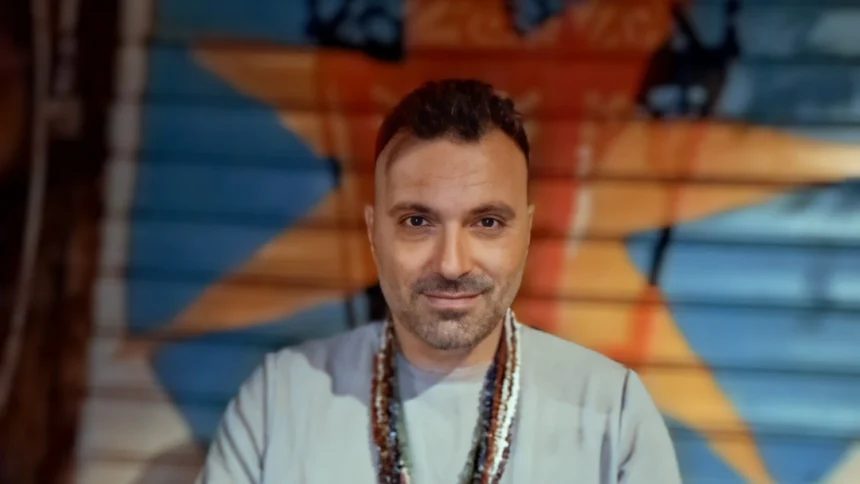
There are artists who make club music, and then there are artists who use the club as a doorway. MIKEY LA LUNA belongs firmly in the second camp. His work doesn’t chase trends or easy highs. Instead, it lingers in that rare space where rhythm becomes ritual and repetition turns into something quietly transformative. With his latest release “Hallelujah,” MIKEY isn’t trying to provoke or preach. He’s listening closely to what already exists between people when sound, movement, and intention align.
“Hallelujah” feels less like a song and more like a shared state. It pulses with late night energy while carrying a spiritual undercurrent that feels ancient and immediate at the same time. The track draws from Hebrew and Arabic vocal traditions, not to make a statement of opposition or fusion, but to gently remind us how close those voices already are. In MIKEY’s world, the dancefloor is not separate from ceremony. It’s simply another place where people gather to feel something together.
His path here is anything but linear. From Georgian ballet and folk traditions to electronic music infused with mantra and trance, MIKEY’s sound is shaped by movement first, theory second. He builds atmosphere through the body, trusting instinct and curiosity over rigid structure. That openness carries into his collaborations too, especially with Daniela Dvash, whose voice anchors “Hallelujah” with a presence that feels grounding rather than ornamental.
Below, MIKEY LA LUNA opens up about the making of “Hallelujah,” the role of repetition and ritual in his music, and why he believes the rave and the ceremony are not opposites, but reflections of the same human need.
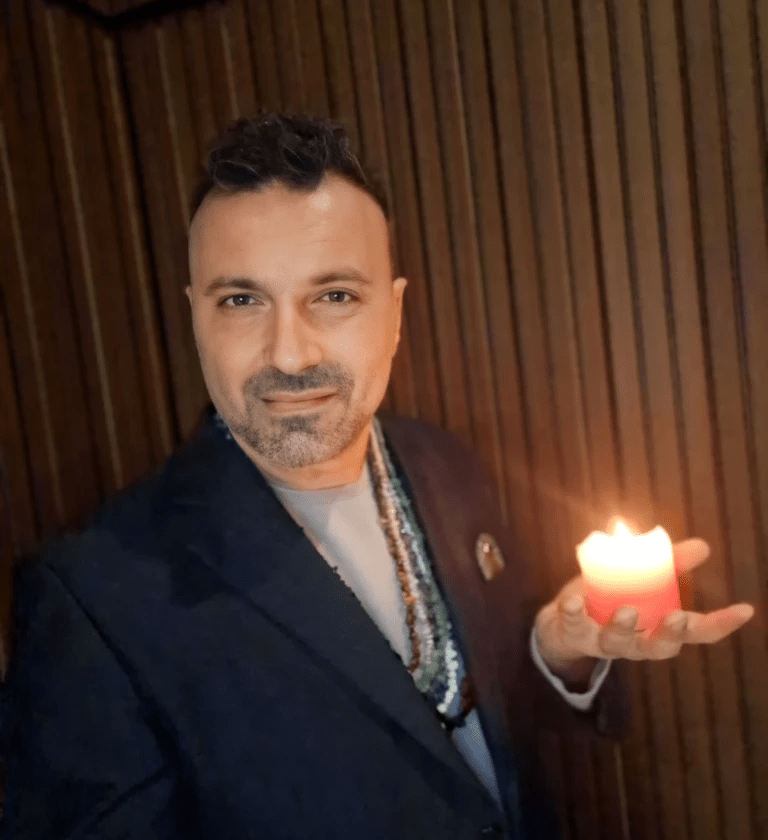
“Hallelujah” exists in a rare space between spiritual reflection and late night club culture. Can you take us into the moment when you first realized this track needed to transform a sacred word into a shared, physical experience on the dancefloor?
It wasn’t an intellectual choice. It was physical.
Late one night in the studio, after hours of repetition, the word Hallelujah stopped feeling like language and started acting like rhythm. Breath. Pulse.
That’s when I realized sacred words don’t belong only to reflection. They belong to bodies. Long before doctrine, they lived in voice, movement, and collective energy. A good club, at its core, isn’t so different.
I didn’t want to make the dancefloor sacred. I wanted to reveal that it already is. When people move together long enough, the word stops pointing upward and starts circulating between us.
The use of Hebrew and Arabic vocals is deeply intentional, yet you emphasize sound and emotion over religious doctrine. How did you navigate the responsibility of working with such historically and spiritually charged languages while allowing them to function purely as musical expression?
Thank you for seeing the intention.
At the core of the track, the idea is very simple. These are not two opposing beliefs. They are two ways of calling the same source. Different words, same direction.
What interested me wasn’t separation, but closeness. When you strip away politics and history, what’s left is the same human impulse: reaching outward for meaning.
The track isn’t about contrast. It’s about recognizing shared ground, and hearing how much more we have in common than we’re taught to notice.
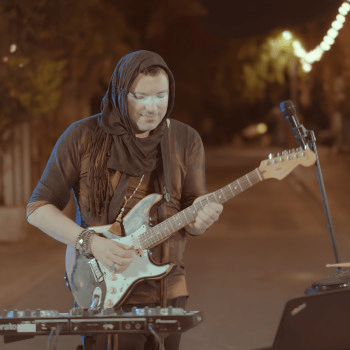
Much of your work feels rooted in ritual, repetition, and altered states. Do you see your performances and productions as modern ceremonies, and how conscious are you of guiding listeners through an emotional or spiritual journey?
I’ve always loved music that moves people. Parties, pop, disco, electronic music. The joy of bodies coming together on a floor was always there for me.
But something shifted when I was exposed to shamanic practices and sacred singing circles. I saw how people could hold space and move others into deep personal and collective states using almost nothing. Sometimes just a voice. Sometimes just a guitar. No production, no volume, just presence.
That experience stayed with me. I realized the rave and the ritual are not opposites. They’re different expressions of the same human need to enter another state together. My project was born from that overlap. From traveling between singing circles and dancefloors and feeling how similar the energy actually is.
I’m still at the beginning of this path. I don’t claim to have answers. I just hope to bring this hybrid experience to more people and let it touch whoever it’s meant to reach.
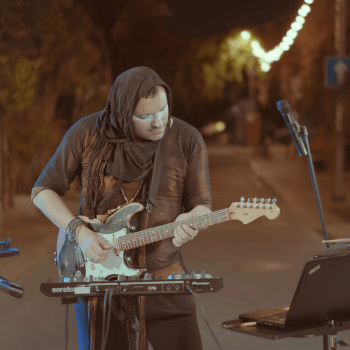
You have spoken about “Hallelujah” as a response to division in the world today. On a personal level, what inner conflicts or questions were you confronting while creating this piece, and how did they shape its emotional core?
On a personal level, this track didn’t come from struggle or overthinking. It almost wrote itself.
Everything arrived naturally. The guitar solo. The melodic line with the church-like tones. The whispered Arabic vocals. There was very little trial and error. I wasn’t searching or forcing ideas. I was following something that already felt complete.
At that time, I wasn’t trying to resolve inner conflict as much as learning to trust flow. To let go of control and allow the music to move through me. It felt like the piece knew where it wanted to go, and my role was simply not to interrupt it.
Daniela Dvash’s vocal presence brings an almost celestial counterbalance to the darker textures of the track. What qualities were you searching for in a collaborator, and how did her voice help complete the spiritual narrative of the song?
Daniela, despite being many years younger than me, is actually my teacher and a spiritual inspiration—for me and for my sons. She was the one who opened the door for me into the world of sacred singing circles.
In one of her circles, she sang a Hallelujah prayer from Psalms, set to her own melody. While I was listening, the same words started playing in my head in a completely different tune—the one that later became the track. In that moment, the song already existed between us.
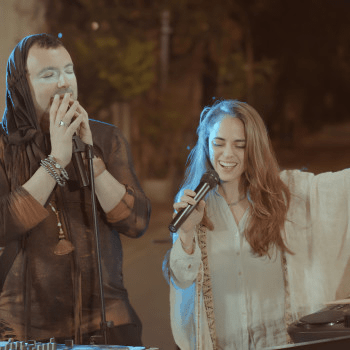
Because of that, it felt obvious and natural that she would be part of it. Her voice doesn’t decorate the track; it anchors it. Even the video came from that same organic place—we filmed it on the very street where we first met. Everything about her presence in the song feels like continuity, not collaboration.
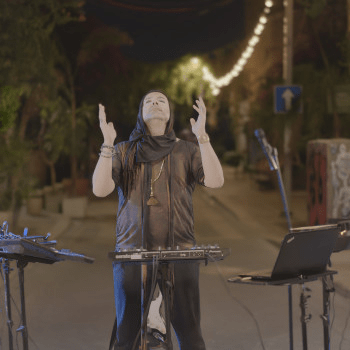
Your artistic path moves from Georgian ballet to folk performance and now into mantra infused electronic music. How have discipline, movement, and embodied expression influenced the way you build rhythm and atmosphere in your productions?
I’ve always been drawn to both worlds. Folklore and electronic music, disco and roots. At first, I was making folk music with electronic touches. Today, it’s electronic music shaped by ancestral influence.
I’m not sure discipline is the right word for my process. What really drives it is curiosity, and a willingness to step outside of comfort zones. Movement came before theory for me. I feel rhythm in the body long before I think about it in structure or genre.
That’s why I don’t follow the rules of a specific style too closely. I’m more interested in what happens when traditions and club culture collide, when roots inform groove without being confined by them. The atmosphere comes from that tension—between what’s familiar and what’s still being discovered.
When composing mantra electronic music, repetition plays a central role. How do you prevent repetition from becoming mechanical, and instead use it as a tool for emotional expansion and transformation?
For me, repetition only becomes mechanical when it’s empty.
Mantras are an ancient tool. They were never meant to be decorative or trendy. They exist to carry intention, to plant something clear and positive through repetition. That’s the secret I’m careful to respect.
When I use repetition, it’s always tied to a message that brings light, grounding, or connection. Not something vague or fashionable. The repetition is there to let that intention sink in, layer by layer, beyond the intellect.
If the message is alive, repetition becomes expansion. It doesn’t numb the listener. It opens them, slowly, and allows something meaningful to take root.
You reference influences like Pink Floyd and Faithless, artists known for blending psychedelia with emotional depth. In what ways did their legacy inform the mood, pacing, and storytelling within “Hallelujah”?
What I took from Pink Floyd and Faithless wasn’t sound but style and storytelling.
They both trusted atmosphere. They allowed tracks to breathe, to unfold slowly, without rushing toward a payoff. Emotion was built over time, not delivered instantly.
In Hallelujah, that influence shows up in the pacing and the space between elements. Letting parts repeat long enough to become immersive. Allowing the story to be felt rather than explained.
There’s also a shared honesty there. Psychedelia not as escape, but as a way to look deeper. That balance—between introspection and collective energy—shaped how the track moves and how it holds emotion.
“Hallelujah” feels equally suited for solitary listening and communal dancefloor moments. How do you balance intimacy and scale when crafting music meant to function both as personal meditation and collective release?
For me, those two experiences are actually the same.
I’m someone who dances during quiet shamanic ceremonies while others are sitting in meditation. And I’m also someone who can step aside at a massive party, close my eyes, and enter a very private inner space while the crowd is moving wildly around me.
Because of that, it’s important to me that the music I make can hold a wide space. It needs to lift, to move bodies, to carry the energy of house and melodic techno. But without dominating the room or forcing a mood.
I want the rhythm and sound to support the moment, not take it over. To function as a soundtrack that fits many situations, allowing each listener to meet it in their own way.
As this release follows your debut EP Embrace the Light, how do you see “Hallelujah” shaping the next chapter of your artistic evolution, both sonically and philosophically?
Hallelujah feels more like a doorway than a conclusion.
After Embrace the Light, there’s already a lot of music alive. Around ten tracks are ready, and more are being created. I plan to start releasing music regularly, about one track a month, while continuing to work and evolve.
Each piece has its own story and depth. This next chapter is about continuity and growth. I invite listeners to follow the journey and be part of it as it unfolds.
STAY IN TOUCH:
FACEBOOK | INSTAGRAM | SPOTIFY | BANDCAMP | TIKTOK | WEBSITE | YOUTUBE