
Music has always been a powerful vehicle for protest, but few artists are willing to completely dismantle the traditional relationship between performer and listener. Blac Narc is doing exactly that with SYSTEM FAILURE, an ambitious project that combines grime, UK rap, punk philosophy and interactive storytelling to create an experience that extends far beyond the boundaries of a conventional album.
At the center of the project are the Double A side singles, “Straight Outta London” and “Mind Control,” two tracks that approach rebellion from opposite directions while remaining deeply connected. “Straight Outta London” channels the frustrations of everyday life into a relentless social commentary, turning rising living costs, Brexit, delayed trains and financial struggles into lyrical ammunition. Rather than relying on abstract political language, the track focuses on real experiences that listeners encounter every day.
In contrast, “Mind Control” explores a more personal battlefield. The song examines self doubt, criticism and the psychological conditioning that can prevent people from recognizing their own value. Together, the two tracks suggest that meaningful change requires both external resistance and internal liberation.
Musically, Blac Narc draws heavily from the rebellious spirit of punk while remaining firmly rooted in grime’s unmistakable energy. His approach reflects the DIY philosophy that shaped both movements, rejecting gatekeepers and refusing to wait for validation from traditional industry structures.
However, the most fascinating aspect of SYSTEM FAILURE may be the Waterfall Puzzle, an intricate Alternate Reality Game designed to transform fans into active participants. Hidden throughout the project are coded messages that listeners must uncover to solve the mystery at the heart of the album.
The ARG challenges fans to analyze hidden Morse code, back masking, timestamp patterns and carefully placed lyrical breadcrumbs scattered across multiple releases. The ultimate objective is to crack a secret four digit master code that unlocks a deeper understanding of the project. Clues have reportedly been hidden in earlier songs, including the second verse of “Simon What” and additional references within “My Style Gets Critical,” rewarding listeners who are willing to investigate beyond the surface.
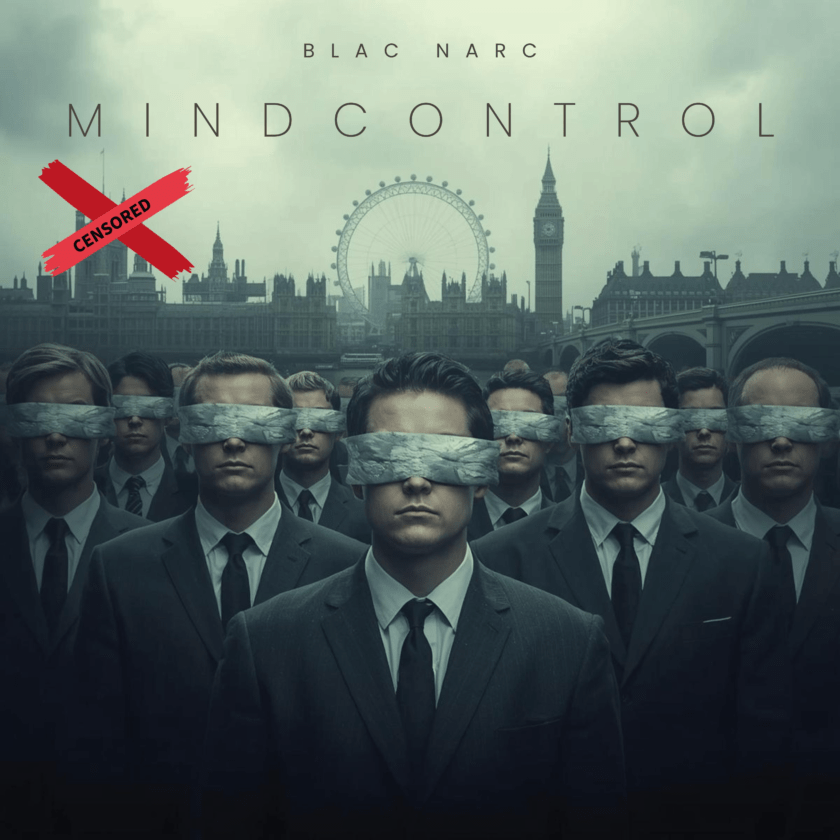
The visual presentation follows the same philosophy. Individual releases function as separate fragments of a larger image, eventually combining to form the complete SYSTEM FAILURE album artwork. The fragmented design mirrors the project’s central message about a society that has become increasingly divided, distracted and disconnected.
Fans who want to begin their investigation can access the official Linktree Vault atlinktr.ee/brighthalogensoundlabs, where additional clues and hidden content connected to the project can be found.
“Straight Outta London” and “Mind Control” approach rebellion from completely different angles. What connects these two songs beneath the surface, and why did they need to exist together as a Double A-side?
They’re two sides of the exact same war. “Straight Outta London” is the external fight the system crushing you from the outside. “Mind Control” is the internal fight people trying to crush your spirit and dictate your worth from the inside. They had to be a Double A-side because you can’t defeat the physical system if your mind is still being controlled by the doubters. You have to win both battles.
“Straight Outta London” turns everyday frustrations such as rising costs, Brexit, late trains and empty bank accounts into rap. Why do you think ordinary frustrations can sometimes become more politically powerful in music than direct political statements?
Because politicians speak in abstracts; the streets live in reality. A manifesto doesn’t mean anything when you’re freezing on a platform waiting for a delayed train, knowing the fare just went up again and your account is in the red. That is politics. It hits harder because it’s universal. I don’t need to preach about the economy when I can just hold up a mirror to the daily grind. The frustration speaks for itself.
Your music carries a strong punk ethos even though the primary language is grime and UK rap. What did punk teach you about making music that refuses to ask permission from the establishment?
Punk is an attitude, not a guitar riff. The Ramones, The Clash, the Sex Pistols, and Black Flag stand as four of history’s most defining punk bands. Together, they forged the sonic landscape, visual style, and rebellious spirit of the US and UK punk scenes. It taught me that you don’t wait for the gatekeepers to hand you a key you kick the door off its hinges. Both punk and grime were born from being marginalised and ignored. The ethos is exactly the same: DIY, raw energy, and zero apologies. I’m a Hip Hop fan, but grime is my tool. We don’t ask permission to speak our truth. Think of it like those old martial arts films where the hero gets defeated and humiliated. In the best ones, they adapt their old style and they learn a new, unconventional style to overcome their adversary that no one has ever heard of like “Golden Chicken Style.” Because no one has seen it, they can’t stop your attack and they have no defence. That’s exactly how I approach the music.
“Mind Control” contrasts your present success with the people who once doubted you. Was that song ultimately written as a response to those people, or as a reminder to yourself of how far you’ve travelled? It’s a reminder to myself.
The doubters are just background noise now, but they were the resistance I needed to build my strength. “Mind Control” is proof that I broke the programming they tried to install in my head. When people tell you you won’t make it, they’re trying to control your reality. The track is me taking the remote back. And you the reader and listener can take it back too.
You are launching SYSTEM FAILURE through an Alternate Reality Game involving hidden lyrical patterns, back masking, timestamps and a four-digit master code. Why was it important for you to make listeners investigate the album rather than simply consume it?
Passive consumption is exactly what got society into this mess. The system wants you scrolling mindlessly, accepting whatever algorithm is fed to you next. I wanted to force people to wake up and pay attention. The clues have actually been dropping for a while if people go back and really listen to the second verse of “Simon What,” the breadcrumbs are already there. Also listen to “My Style Gets Critical” The ARG makes you an active participant. If you want the truth in this world, you have to dig for it, decode it, and question it. Like the Matrix.
The artwork itself becomes part of the puzzle, with individual releases eventually forming the final album cover. Did you approach the visual identity first as artwork for music, or as pieces of a much larger story that only becomes clear when everything is assembled?
It was always a larger story. Society is fractured right now, and the artwork reflects that brokenness. Every single drop is an isolated fragment that feels incomplete on its own. It’s only when you step back and piece the releases together that you see the whole picture. The visual identity is a metaphor for the entire SYSTEM FAILURE concept.
There is an interesting tension between the entertainment value of a 140 BPM grime track and the seriousness of the social realities you’re addressing. How do you make political or systemic commentary feel like music people genuinely want to replay rather than simply a message they are expected to hear once?
The beat is the Trojan horse. 140 BPM is the heartbeat of London it makes you want to move, skank, and release energy. If you come at people like a politician, they tune out. But if you give them a rhythm that shakes the subwoofers, you’ve bypassed their defences. They start reciting the lyrics because the flow is infectious, and suddenly, they’re internalising the message without even realising it.

Your writing draws from complex wordplay, confrontation and unconventional production. When you’re constructing a Blac Narc track, which comes first: the idea you want to challenge, the words you want to say, or the sonic world that allows you to say them?
The anger comes first. It’s always the idea or the frustration I need to get out of my system. Then, I look for the sonic landscape that matches my blood pressure. Once the atmosphere of the beat aligns with the concept, the complex wordplay and the confrontation just bleed out naturally.
The phrase “SYSTEM FAILURE” sounds like both an accusation against society and a diagnosis of something broken. What, in your view, is the biggest failure of the system you’re trying to expose through this project?
The illusion of choice. We are conditioned to believe we have control over our lives, our money, and our futures, but the house always wins. The system is designed to keep us running on a treadmill, exhausted, distracted, and pointing fingers at each other instead of looking up at the people holding the leash. This generation of young people need to wake up and that is why I wanted to add a bit of punk rock to the mix of Mind Control with the “Headbanger Mix”
If a listener successfully solves the Waterfall Puzzle and reaches the end of the SYSTEM FAILURE journey, what do you hope they understand about Blac Narc that they couldn’t have discovered simply by listening to the songs?
I hope they realise that they aren’t just consumers; they’re operatives capable of breaking the conditioning. To get to the end of the puzzle, you have to unlearn how you usually listen to music. As for the master code itself you just have to trace the journey. It’s about survival in this city. You burn through nine lives just trying to make it, break through the four walls they built to keep you in, realise it’s a two tier society, and finally find the three truths they tried to hide. Cross reference that with what’s buried in that second verse of “Simon What,” and the lock opens. If they grasp that, they understand exactly what Blac Narc is about. Be the best version of you and achieve your dreams. It’s never too late to change. I left school with no qualifications. But now I’m back with 2 degrees.
STAY IN TOUCH:
TIKTOK | X | SPOTIFY | YOUTUBE | WEBSITE | INSTAGRAM