
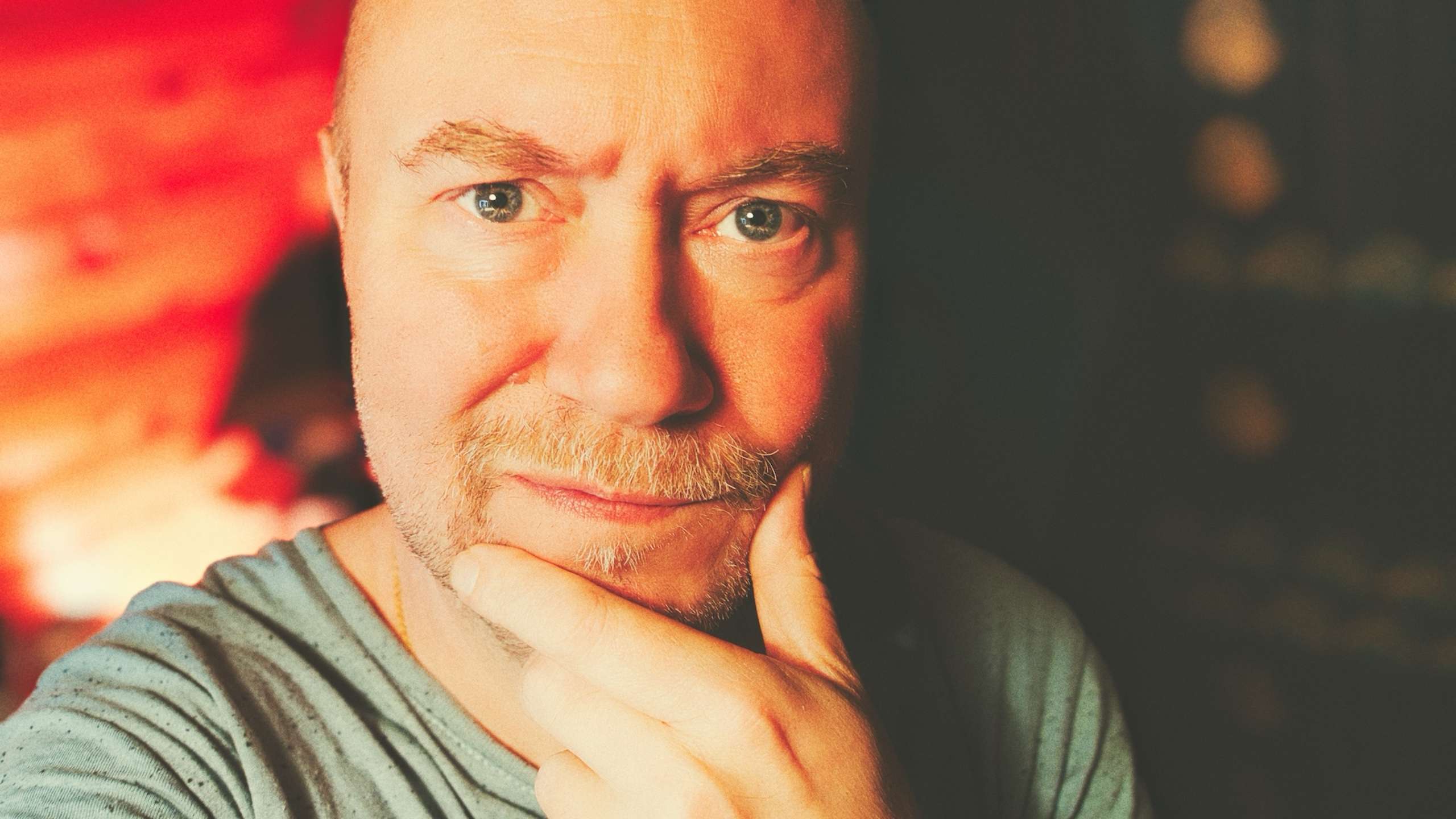
BigDenBoo is a music veteran whose passion for synthesizers and electronic music began in the early 1980s. Inspired by pioneers such as Jean-Michel Jarre and Vangelis, he has spent years exploring sound design, cinematic atmospheres, and the creative possibilities of electronic production. His Musical Adventures saga has grown into an ambitious audiovisual project, combining intricate compositions, immersive storytelling, and 3D visuals to bring an expanding fictional world to life.
His third album, Forgotten Stories, continues that journey, revisiting characters and narratives while exploring the balance between modern production tools and the discipline of traditional recording techniques.
In this interview with Spinex Music, BigDenBoo discusses his musical beginnings, the synthesizers that shaped his sound, the creative process behind Forgotten Stories, and his plans for the next chapter of his evolving musical universe.
How did your journey into music begin, and how did your early experience as an apprentice organist eventually lead you to discover your passion for synthesizers and electronic music?
As a child, I studied the organ at a conservatory. This experience naturally gave me my first encounter with keyboard instruments. However, once I reached my teens, I found myself less interested in the sound of an organ, just as pop music was seeing the emergence of synthesizers across various musical styles. My interest then shifted, quite naturally, toward these new instruments.
You describe yourself as a music veteran who fell in love with synthesizers during the era of instruments such as the Roland JX-3P, Yamaha DX7, and Korg Poly-800. What was so exciting about that period, and how did those instruments shape your musical imagination?
I discovered synthesizers in the early 80s. At that time, my main references were primarily Jean-Michel Jarre and Vangelis. What was so groundbreaking back then was that manufacturers were offering polyphonic, creative instruments for the first time, and at much more affordable prices. I remember spending an uncountable amount of time in music stores just exploring these machines. It was right before the revolution that the DX7 brought.
These instruments, much like a “Madeleine de Proust”, have definitively shaped my musical imagination.
“Forgotten Stories” is the third chapter in your Musical Adventures saga. What inspired you to create this series, and is there a larger story connecting the different chapters?
To be honest, it all started from… nothing. Just before the summer of 2022, it was nothing more than a simple experiment, with the sole purpose of trying to compose in a genre I had never explored before. That resulted in four tracks.
But from that moment on, a more structured project began to take shape in my mind, at first as a story about sailors going into battle against pirates. Then, I began to build an entire world in which to place and develop this story.
From 2022 to 2025, this world has grown significantly. There is the plotline told in the three albums, but also a much larger reality that I intend to explore in future ones.
You describe “Forgotten Stories” as an audiovisual experience rather than simply a piece of music. How do you approach combining sound and visual storytelling, and which usually comes first when you begin a project like this?
During the production of “The Journey,” my first album, it was rather… chaotic. As I mentioned earlier, I initially composed four tracks and then attached a story to them. For the rest of the album, the process was reversed: I had the storyline first, and I composed based on that.
For “Lostblood” and “Forgotten Stories,” the narration is almost always imagined before the music. With a few exceptions, of course.
The 3D visuals created with Blender to accompany the tracks are generally produced last. However, certain experiments do sometimes influence the narrative.
The release blends cinematic atmospheres with modern electronic production. How do you decide which sounds, textures, and rhythms will help communicate the mood of a particular scene or moment in your compositions?
I don’t have a magic formula that I apply to every track.
There are, of course, choices that feel natural, especially when dealing with acoustic elements like pianos, strings, or brass.
For synthetic sounds, I love creating textures from scratch as soon as I have a clear idea of the result I want to achieve. This is especially true with analog-style virtual instruments or my Novation Summit. I also frequently rework presets, though more rarely, I use some ‘as is.’ I tend to disable the built-in effects of my instrument plugins so that I can manage them more holistically through my insert effects.
Finally, the rhythmic sections often rely on a juxtaposition of different instruments.
You mention high-fidelity sound design and complex compositions. As someone who is passionate about mixing, how important is the technical side of production to you, and how do you make sure that the details serve the overall emotional experience?
On this subject, I’m a bit of a… psychopath! I spend an incredible amount of time working on the arrangements, sound design, and mixing all together.
The title “Forgotten Stories” suggests memories, lost histories, or worlds waiting to be rediscovered. What does the title mean to you, and what would you like listeners to imagine as they experience the music?
There are two possible readings for this title, and both are “valid”:
First, “Lostblood,” the second album, focused on the quest of young Tyler Becker to find his brother, leaving many characters introduced in my first album “on the side of the road,” so to speak. “Forgotten Stories” repairs this “oblivion.” That is the primary meaning of the title.
But I am also implying that, on a global scale, these stories have little chance of passing into posterity. They are important stories for their protagonists, but they will undoubtedly be forgotten by those who cross paths with them. At least for now.
Having worked with music across different generations of technology, how has your approach to electronic production changed over the years, and are there aspects of older synthesizers or recording methods that you still prefer to modern tools?
Modern technologies provide us with an overwhelming array of means for music production. What we can do today with a simple laptop was unimaginable a few decades ago.
But it is also a trap, the urge to always do more. When music is played by musicians and recorded on magnetic tape, it imposes constraints that force you to think pragmatically, whether in terms of arrangements, recording, or mixing. You have to get to the essence of things.
With this third album, I wanted, in my own way, to return to that pragmatism, without forgoing today’s technologies. The idea was quite simple: let’s try to think of the arrangements as if the final mix of each track had to be recorded on a 24-track tape machine. And for the mixing itself, I wanted to bring my workflow as close as possible to what I would have done on an analog console.
You describe yourself as passionate about sound in all its forms. Outside traditional musical instruments, where do you find inspiration for new sounds, and have you ever discovered an unexpected sound that became central to a composition?
Yes, it has happened several times, especially in the first two albums, where a sound discovered on either hardware or virtual instruments has oriented a composition or its arrangement.
As you continue expanding the Musical Adventures saga, what new ideas or creative challenges would you like to explore, and how do you hope your work will evolve as you keep building immersive worlds through sound?
For the Musical Adventures, I am trying to shape a world that is much larger than what the first albums present. I think this will be a source of inspiration during the conception of the sequel, allowing me to introduce elements that stand out from what has already been achieved. If we look at the map of Fãlherilh on the website, you can see that the geography itself is a potential source of inspiration.
And then there is the story of the main protagonists, which has not, far from it, revealed all its secrets. But there, I can’t say any more!